Field guide · Agent runtimes · July 2026 · updated
Agent harnesses compared: open, closed, and the messy middle
OpenClaw, Hermes, OpenCode, Pi - and the three lab coding agents most people actually sit in front of: Claude Code, Codex, and Grok Build. What a harness provides, how open vs closed really splits, why people pick one over another, and live star counts.
1. What a harness actually provides
When people say "agent," they usually mean a model + a harness. The model reasons. The harness is everything that makes reasoning useful:
Execution
- Tool loop (call → observe → continue)
- File ops, shell, LSP, browser, MCP
- Subagents, plan mode, parallel work
State
- Sessions, branching, compaction
- Long-term memory / retrieval
- Skills, plugins, marketplaces
Control
- Permissions, sandboxes, path guards
- Steer / interrupt mid-run
- Model routing, rollback, audit
Surface
- TUI, desktop, IDE, web, mobile
- Chat apps (Telegram, Slack…)
- Cron / gateway / cloud dispatch
2. Open vs closed - the real axes
Discourse often collapses to "open source good / closed bad." Builders actually choose along three separate axes:
| Axis | What it means | Why it matters |
|---|---|---|
| Harness license | Can you read, fork, self-host, audit the agent loop? | Escape hatches, custom tools, compliance review |
| Model / API lock-in | Do you need that lab's subscription/API? | Cost, data residency, rate limits, vendor risk |
| Product surface | TUI only vs cloud agents vs messaging OS | Who runs the process and where secrets live |
Where each product actually sits (2026-07-25)
| Product | Harness | Typical model | License note |
|---|---|---|---|
| Claude Code | Closed product | Claude (Anthropic) | Public GitHub (~139k ★) but no SPDX open license - treat as proprietary |
| Codex CLI | Open (Apache-2.0) | OpenAI / ChatGPT plans | Rust CLI open; cloud Codex is a managed service |
| Grok Build | Open (Apache-2.0) | Grok / SuperGrok / API | Rust harness open-sourced (xai-org/grok-build); model still xAI |
| OpenCode | Open (MIT) | Any of 75+ providers | BYOK open coding product |
| Pi | Open (MIT) | Any / local | Minimal toolkit; max forkability |
| Hermes | Open (MIT) | Any / local | Self-improving general agent |
| OpenClaw | Open (source available) | Any (ChatGPT sign-in etc.) | Personal multi-channel assistant; huge ecosystem |
Practical takeaway: if your constraint is auditability / BYOK / local, start with OpenCode, Pi, Codex CLI (harness), or Grok Build (harness). If your constraint is max interactive coding reliability, community still points at Claude Code first, with Codex as the ChatGPT-native peer. If your constraint is always-on multi-channel life, that is OpenClaw/Hermes territory - not Claude Code.
3. GitHub stars snapshot
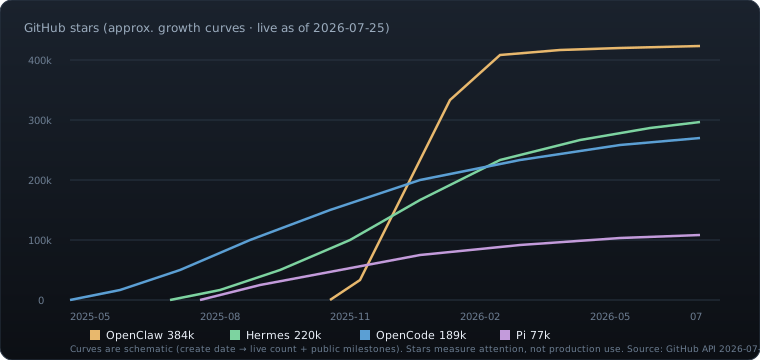
Live via GitHub API on 2026-07-25. Stars measure attention, not "best for production."
Always-on / community agents
| Repo | Stars | License | Lang | Role |
|---|---|---|---|---|
| openclaw/openclaw | 384,048 | source-available | TS | Personal multi-channel assistant |
| NousResearch/hermes-agent | 220,039 | MIT | Python | Self-improving agent |
| anomalyco/opencode | 189,407 | MIT | TS | Open coding agent product |
| anthropics/claude-code | 138,973 | no open SPDX | Python/npm | Anthropic coding product |
| openai/codex | 101,252 | Apache-2.0 | Rust | OpenAI coding agent CLI |
| earendil-works/pi | 77,084 | MIT | TS | Minimal coding harness |
| xai-org/grok-build | 22,354 | Apache-2.0 | Rust | xAI coding agent TUI/harness |
Interactive multi-repo charts: star-history.com (all seven).
4. Claude Code, Codex, Grok Build (lab desk agents)
These three dominate "what do I run in the terminal for serious coding?" They are the quality bar open harnesses chase - and often the workers that OpenClaw/Hermes shell out to.
Claude Code - proprietary depth leader
≈139k ★ on GitHub · Anthropic · no open SPDX license · code.claude.com
Anthropic's agentic coding product: terminal, IDE plugins, desktop, web, GitHub tagging. Community consensus in comparisons (Firecrawl, Omid Saffari, ByteIota, etc.): safest default for multi-file refactors and production-grade interactive coding. Strengths: maturity, ecosystem, long-context workflows, "it just works" depth. Weaknesses: vendor lock to Claude, subscription cost, cannot truly fork the product (despite a public repo).
Codex - open CLI, ChatGPT-native cloud
≈101k ★ · Apache-2.0 · Rust · openai/codex
Two faces: Codex CLI (open source, local) and Codex cloud / app (managed sandboxes, PR workflow, ChatGPT surfaces). OpenAI markets weekly shipping velocity and high weekly active use. Community loves: sandbox-first safety, speed, ChatGPT plan inclusion, open harness for builders. Community friction: guardrails "too safe" for some tasks; free/Go plan usage limits.
Strategic open-source play: app-server and CLI so other tools can build on Codex auth/usage - OpenAI has publicly contrasted this with closed competitors.
Grok Build - open harness, xAI models, watch the cloud path
≈22k ★ · Apache-2.0 · Rust · xai-org/grok-build · docs.x.ai/build
Fullscreen mouse-interactive TUI, headless mode, ACP for editors, custom models via ~/.grok/config.toml. Pitched as SuperGrok / X Premium Plus coding agent; harness source is open and buildable. Strengths: cost if you already pay for X/SuperGrok; extensibility; open Rust codebase. Risks: still maturing vs Claude Code; July 2026 reports that the CLI uploaded full git bundles to cloud storage (uploads stopped; Musk said prior uploads would be purged) - a trust scar for enterprise and security-minded users.
5. The four open community harnesses
OpenClaw - personal AI in your chats
≈384k ★ · TypeScript · openclaw.ai
Always-on multi-channel assistant (WhatsApp, Telegram, Discord…). Control plane + ClawHub marketplace. Not a pure coding TUI - it often delegates coding to Claude Code / Codex / OpenCode. Love: ecosystem scale, "lives in Telegram." Risk: weight, update churn, shell+messaging blast radius.
Hermes Agent - self-improving ops runtime
≈220k ★ · Python · MIT · Nous Research
Learning loop, memory, cron/VPS, desktop apps, OpenClaw migration. Outer agent that improves at your workflows. Love: skills from experience. Risk: token hunger; not always best pure coding desk agent (people shell out to OpenCode/Claude Code).
OpenCode - open coding product
≈189k ★ · MIT · opencode.ai
Terminal + desktop + IDE; LSP; multi-session; 75+ providers. The open "Claude Code alternative" when you want BYOK and product polish. Tradeoff vs Pi: more UX, more context weight.
Pi - minimal harness you reshape
≈77k ★ · MIT · pi.dev
Four tools, tiny system prompt, TypeScript extensions. Best token budget for local models; foundation under larger products (OpenClaw integration cited by Pi). Tradeoff: more DIY unless you use omp (oh-my-pi).
6. Head-to-head matrix (coding desk agents)
| Dimension | Claude Code | Codex | Grok Build | OpenCode | Pi |
|---|---|---|---|---|---|
| What it is | Anthropic coding agent product | OpenAI local CLI + cloud agents | xAI coding TUI / harness | Open BYOK coding agent | Minimal coding toolkit |
| Harness open? | No (public repo, closed license) | Yes (Apache-2.0) | Yes (Apache-2.0) | Yes (MIT) | Yes (MIT) |
| Stars | ~139k | ~101k | ~22k | ~189k | ~77k |
| Model freedom | Claude family | OpenAI + plan auth | Grok + custom models config | 75+ providers | 15+ / local easy |
| Philosophy | Max interactive depth | Sandbox + open CLI + cloud | Fullscreen TUI + open runtime | Productized open coding | Primitives, not features |
| Best for | Hard multi-file production work | ChatGPT users; safe autonomy | X/SuperGrok users; open TUI | BYOK open desk coding | Local models; custom harnesses |
| Watch-outs | Vendor lock; cost | Guardrails; plan limits | Maturity; past upload incident | Heavier than Pi locally | More DIY setup |
OpenClaw and Hermes intentionally omitted from this coding-desk table - they win on always-on multi-channel life ops, not Terminal-Bench style desk coding. See sections 5 and 7.
7. Why people choose one over another
Claude Code if…
- You optimize for coding reliability over openness
- Multi-file refactors and long agent sessions
- You already pay Anthropic Max/Pro
Codex if…
- You live in ChatGPT and want included agent usage
- You want an Apache-2.0 CLI to audit/fork
- Cloud sandbox / PR-centric workflows matter
Grok Build if…
- You already pay SuperGrok / X Premium Plus
- You want an open Rust TUI harness
- You accept newer product + verify network defaults
OpenCode / Pi if…
- BYOK, multi-provider, or local models
- You want MIT code you fully control
- Pi for thin prompts; OpenCode for polish
OpenClaw if…
- Always-on multi-channel assistant
- Marketplace skills (ClawHub)
- Coding is delegated to a desk agent
Hermes if…
- Self-improving automations + memory
- VPS/cron personal ops
- Migrating from OpenClaw with skill import
Composition (what "the stack" looks like)
- Outer: Hermes or OpenClaw for messaging, cron, memory.
- Inner coding: Claude Code, Codex, Grok Build, OpenCode, or Pi.
- Cross-lab plugins exist: e.g. Codex plugin for Claude Code; Grok Build plugin for Claude Code - the market is already multi-harness.
8. How to pick (short decision tree)
- Is the primary job always-on chat / life ops? → OpenClaw or Hermes.
- Is the primary job interactive coding?
- Max quality, accept closed product → Claude Code.
- ChatGPT plan + open CLI → Codex.
- X/SuperGrok + open TUI → Grok Build (verify privacy defaults).
- BYOK multi-provider product → OpenCode.
- Local / minimal / embeddable → Pi (or omp).
- Do you need both? Compose outer + inner. Do not force one harness to be everything.
- Security: any shell agent is a junior engineer with your keys. Sandbox first. Marketplace skills second. Read what the binary uploads.
9. Methods and caveats
- Community signal: two last30days-style sweeps - (1) OpenCode/Pi/Hermes/OpenClaw, (2) Claude Code/Codex/Grok Build - across Reddit, HN, YouTube, Digg/Techmeme, GitHub project mode, plus direct X search (engine X auth not configured locally).
- Stars & licenses: GitHub API 2026-07-25. Claude Code has no open SPDX license despite a public repo - call it proprietary for practical purposes.
- First-party: opencode.ai, pi.dev, openclaw.ai, hermes-agent.nousresearch.com, docs.x.ai/build, openai/codex, anthropics/claude-code, plus public comparison essays.
- Bias: written for builders choosing a stack, not enterprise procurement checklists.